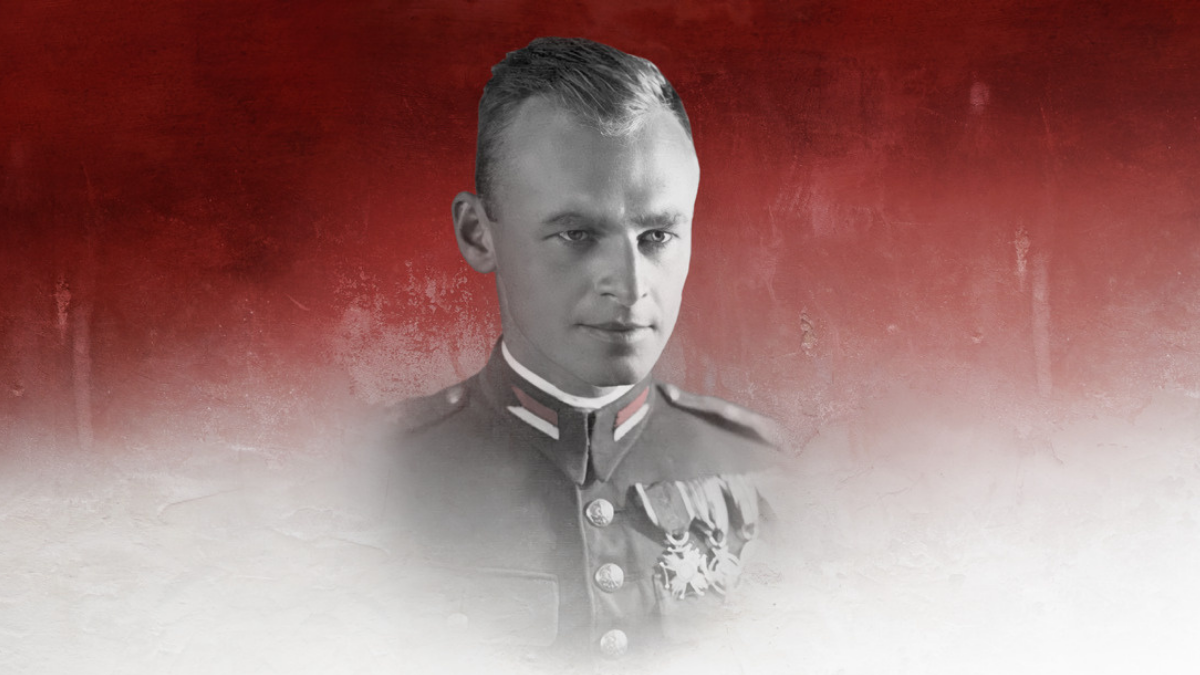
One of the greatest heroes of the World War II, Witold Pilecki deliberately entered Auschwitz to expose Nazi German crimes. After escaping, he delivered some of the first eyewitness reports on the Holocaust. Instead of being honoured as a hero after the Second World War, Pilecki was imprisoned, tortured at Rakowiecka Prison and sentenced to death by the communist authorities in Poland.
Cavalry Captain Witold Pilecki, military officer, member of the Polish resistance in World War II and intelligence agent of the anti-communist underground was undoubtedly an example of extraordinary courage and moral responsibility.
During the German occupation of Poland, he voluntarily entered the concentration camp KL Auschwitz as a prisoner to document Nazi-German crimes. Despite the significance of his Auschwitz reports, his merits remained largely unknown for decades after his death due to political repression and censorship in communist Poland.
Witold Pilecki was born on May 13, 1901, in Olonets, in the province of Karelia in the Russians Empire, close to the Finish border, where his father Julian Pilecki had been assigned a job as a forest engineer. Since the end of the 18th century Poland had been partitioned between three occupying powers, including the Russian Empire. The policy of allocating members of the Polish intelligentsia in remote parts of the empire was an intentional policy on the part of the tsarist authorities aiming at depriving Poles of their national identity. It was one of many forms of retaliation for the Polish independence struggle in the January Uprising of 1863 in which also Witold’s grandfather had fought.
Especially thanks to their mother, Ludwika née Osiecimska, Witold and his siblings were raised in a strong sense of Polish patriotism. From a young age, Witold was taught the importance of service and sacrifice – values that would shape his entire life.
In 1910, the Pilecki family moved to Vilnius where Witold pursued his education and became involved in underground Polish scouting organizations, which prepared young people for the struggle to restore Polish independence. When Poland’s occupiers engaged in the armed conflict of World War I on opposing sides, an unprecedented opportunity in the fight for independence emerged. Together with his scouting unit Pilecki fought in the defense of Vilnius – first against the Germans and then against the Soviets. In 1918, a sovereign Polish state reappeared on the map of Europe but its existence was fragile and soon had to be defended in the next war, During the Polish-Soviet War of 1920, as member of the 211th Uhlans Cavalry Regiment, he took part in battles around the Polish capital, in which Polish forces defeated the advancing Bolshevik Army.
In the years after the war, Pilecki continued his education and military training and managed his family’s estate in Sukurcze near Lida where he served the local community. In 1931, he married Maria Ostrowska and raised two children, Andrzej and Zofia.
On September 1, 1939, Poland was attacked by Germany, and soon the Soviets invaded from the east. During the defensive war against Germany, Witold Pilecki fought as commander of the cavalry squadron of the 19th Infantry Division, which was part of the Polish Army unit “Prusy”. After the defeat against Hitler’s forces, he ignored the recommendation to evacuate to Hungary and made his way to Warsaw, where he soon became involved in the underground resistance movement.
Together with major Jan Włodarkiewicz, a comrade from his former brigade, Witold Pilecki established the Secret Polish Army (Tajna Armia Polska, TAP) in November 1939, one of the earliest resistance organizations. TAP would eventually be incorporated into the Union of Armed Struggle (Związek Walki Zbrojnej, ZWZ), later the Polish Home Army (Armia Krajowa, AK), which reported to the Polish government in exile (established in France and then transferred to London). In the summer of 1940, reports were emerging about the gruesome treatment of prisoners at the newly built German concentration camp KL Auschwitz, but little reliable information was available. Witold Pilecki agreed to carry out a plan of infiltrating the camp made by TAP’s command in coordination with ZWZ commander col. Stefan Rowecki “Grot”. Having been provided with forged documents under the name “Tomasz Serafiński”, he purposefully allowed himself to be captured during a roundup conducted by the gestapo, the German secret state police, in Warsaw on September 19,1940 and was transported to Auschwitz.
Upon his arrival in the camp, Pilecki soon discovered that conditions there exceeded even his worst expectations. He would later write in his report:
I consider this place in my story to be the moment when I bade farewell to everything I had hitherto known on this earth and entered something seemingly no longer of it. […] Our concepts of law and order and of what was normal, all those ideas of which we had become accustomed on this earth were given a brutal kicking[i]
Prisoners were subjected to starvation, disease, forced labor, torture, and constant violence. With these methods the Germans tried to deprive the prisoners of their humanity and extinguish any will of resistance. In these conditions, Pilecki began building a secret underground network within the camp, which he named Military Resistance Organization (Związek Organizacji Wojskowej, ZOW).
To ensure secrecy, ZOW was organized in a cell network of “Fives”, whereby five agents knew of one another but of no other members of the organization. Pilecki recruited trusted inmates, organized mutual assistance, shared information, and gathered intelligence about the atrocities in the camp. ZOW also assassinated particularly cruel SS officers and kapo (prisoner functionaries), for instance, by infecting them with typhus using lice that carried the disease. The moral weight of ZOW should also not be underestimated: The existence of a resistance restored the prisoners’ dignity and sense of purpose. ZOW members lived and died with the awareness that they continued the fight against the German occupier.
Through contacts with the Polish resistance outside the camp, Pilecki’s reports reached the Polish government-in-exile and the Allies. They provided some of the first accounts about the mass extermination of Jews. Pilecki was preparing the members of his organization for an uprising in the event of an Allied operation to liberate the camp – something he repeatedly urged his commanders to consider. However, both the AK’s command and its allies deemed such an operation too risky and its success unlikely. In April 1943, after two years and seven months, Witold Pilecki considered his intelligence mission accomplished and escaped the camp together with two other prisoners, Jan Radziej and Edward Ciesielski. He prepared his first comprehensive report describing the conditions and atrocities in the camp. After the war, he would write a second more detailed report.
Pilecki returned to Warsaw where he continued to work for the Polish resistance. He served in Division II of the Home Army’s Directorate for Subversion (Kedyw) and then NIE (Niepodległość), a secret cell that was building the structures of an underground resistance for the event of a Soviet occupation. When the Warsaw Uprising began on August 1, 1944, Witold Pilecki was not assigned any role in the armed struggle (because of his duties in NIE). Nevertheless, he decided to join the fight to liberate the capital. As part of the unit Chrobry II, he was defending one of the most important intersections in mid-town.
When the uprising was crushed, Pilecki was captured by German forces and held as a prisoner of war at the camps Lamsdorf and Murnau, liberated by U.S. troops in April 1945. He made his way to Italy where the II Corps of Polish Armed Forces in the West under General Władysław Anders was stationed.
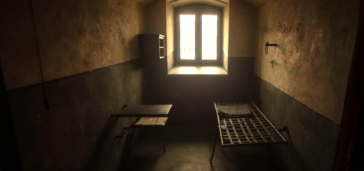
In late 1945, Pilecki returned to Poland with instructions from General Anders to conduct intelligence work on the situation in the country. While Germany had been defeated, the Soviets had forced a communist government upon Poland, backed by the political terror of the Soviet security apparatus NKVD and the Red Army. Pilecki built a network, made up of some of his war-time contacts, which gathered information on the gradual Sovietization of the country and repressions by NKVD and its newly establish Polish counterpart, the UB (the organs of the Ministry of Public Security). The group also established contacts with partisan groups of the anti-communist underground. Although the situation was becoming increasingly dangerous, Pilecki decided against leaving Poland: “I will stay, we cannot all leave, someone must remain regardless of the consequences,” he stated. In May 1947, the communist secret police UB arrested Witold Pilecki and several members of his network. Imprisoned at Rakowiecka 37, Pilecki was subjected to severe torture by interrogating officers, notably Eugeniusz Chimczak, who was known for his sadistic nature.
On March 3,1948, the showcase trail of Witold Pilecki and seven other members of his group began at the Miliary District Court in Warsaw. The state prosecutor Czesław Łapiński charged the group with high treason, plotting terrorist acts against the state and espionage on behalf of the “imperialist” Western powers. Witold Pilecki denied these accusations stating that he had served Poland his entire life. He had never served any foreign powers but provided information to Polish organs (the II Corps and the Polish government in excite).
The court presided over by judge Jan Hryckowian sentenced Witold Pilecki, Maria Szelągowska and Tadeusz Płużański to death (subsequently changed to life in prison for the latter two), Makary Sieradzki to life in prison and the other members of the network to several years of prison. On May 25, 1948, Witold Pilecki was executed by a gunshot the back of the head on the premises of the Mokotów prison and secretly buried in an unknown place. Like many other families of political prisoners during the Stalinist period, Pilecki’s wife Maria and their children were subjected to repression. Maria Pilecka, a teacher, could not find employment while her daughter was forced to abandon her university education.
For decades, the memory of Witold Pilecki’s heroic achievements was suppressed by communist propaganda. His Auschwitz reports, which the UB had obtained, remained sealed in the state archives. The first accounts about his reports and organization of a resistance in Auschwitz appeared not in Poland but in Western Europe. Only after the collapse of communism in Poland did historians begin fully uncovering his story. In 1990, the Chief Military’s Prosecutor’s Office revised his case, and the verdict of 1948 was declared unlawful and repealed. Witold Pilecki has since been recognized as one of Poland’s greatest national heroes and the significance of his reports from Auschwitz has been acknowledged internationally.
Text by Maria Krasnodębska, historical consultation by Anna Śnieżko
[i] Garliński Jacek (transl.) The Auschwitz Volunteer: Beyond Bravery, 2012