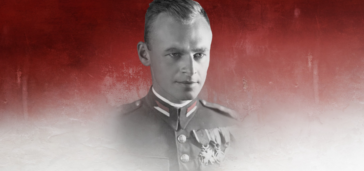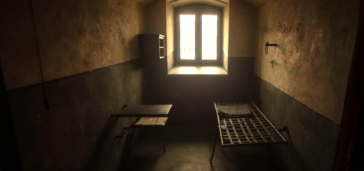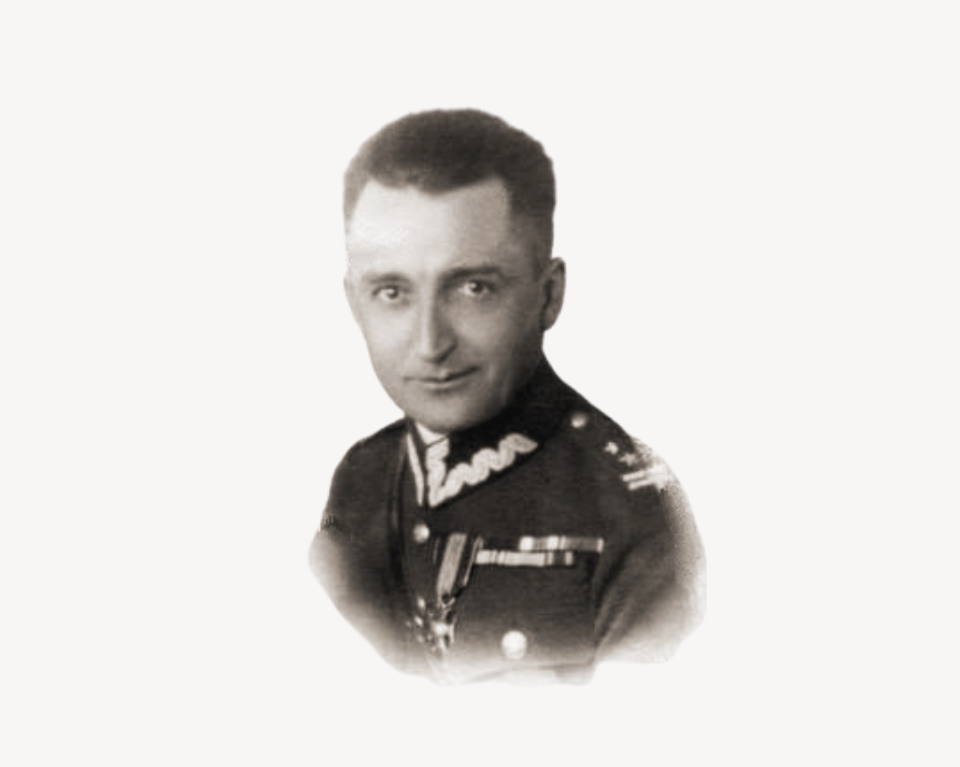
One of Poland’s greatest wartime commanders, General Emil Fieldorf „Nil” fought Nazi Germany throughout the Second World War. In a tragic twist of history, the communist regime falsely accused him of collaborating with the enemy and executed him in 1953. Discover the story of a man whose final days ended at Rakowiecka Prison, where his memory is honoured today.
General August Emil Fieldorf codename “Nil” was one of the most outstanding Polish commanders. His military experience included fighting for Poland’s independence during the Great War and thereafter. During the Second World War, he fought in the defense of Poland against the German invader and during the occupation joined the underground resistance, the Polish Home Army (AK). He was also one of the most respected and decorated military personnel, receiving his first battle medal – the Cross of Valour – at the age of 24.
Emil (he used own middle name) was born on March 20, 1895 in Cracow. He was one of four children of Andrzej Fieldorf, a train driver and Agnieszka, née Szwand. At the age of 17, Emil joined the Rifle Union, a military training organization for young men who later made up the Polish Legions – Polish military formations within the Austro-Hungarian Army. The outbreak of the First World War meant that Poland’s occupies went to war against one another. As a result, the chances of regaining independence for Poles after over a century of partitions were now more realistic than ever.
Already in August 1914, 19-years-old Fieldorf volunteered for the troops joining the struggle for independence. Although a sovereign Polish state emerged in 1918, the fighting continued. As soon as the German troops retreated, an armed struggle against the Soviets began. Polish troops repelled the enemy and in April 1919 entered Vilnius. Lieutenant Fieldorf of the 1 Legions Infantry Regiment took up combat positions in the vicinity of the Green Bridge atVileyka River with the task of defending the crossing. For his courage in this battle he was awarded the Cross of Vilnius and the Cross of Valour.
In 1919 he met miss Janina Kobylińska, whom he married after a few months’ acquaintance. Their marriage and love survived the hardest moments until his death. Soon after the wedding, the young husband had to return to the battlefield to fight against the Soviets who were attacking Poland’s territories in the east attempting to export the communist revolution further into Europe. In the Polish-Soviet War of 1920, Emil Fieldorf fought at Kiev and Zhytomyr. After the war he settled down in Vilnius, where he served in the 1st Infantry Regiment of the Legions. His daughters, Krystyna and Maria, were born there.
A year before the war Fieldorf became lieutenant colonel and commander of the 51st Infantry Regiment in Brzeżany. On 3 September 1939 he went to the frontlines with his regiment, which was part of the 12th Tarnopol Infantry Division. After the fighting in the vicinity of Skarżysko- Kamienna, where Fieldorf’s soldiers covered the retreating troops, casualties amounted to 70% of the regiment’s original state – one in three soldiers remained alive. Faced with the advantage of the enemy, Colonel Fieldorf’s order was brief: “There is no captivity, push through with arms.”
Officers of the 51st regiment broke through the enemy’s encirclement in small groups. However, after escaping from the trap near Susiec in the Lublin region, they learned that Poland had been attacked by the Soviets from the east on September 17. In this situation, they decided to get to Cracow in civilian clothes, and from there to France, to the reconstituted Polish army.
In Paris, Colonel Fieldorf was assigned to the staff of General Kazimierz Sosnkowski, head of the Union of Armed Struggle. Wishing to return home, he was preparing for a courier mission. The fall of France and the evacuation to England delayed his plans. After his briefing on 17 July 1940, he left London by ship from Liverpool to Cape Town, South Africa, then by air north to Cairo (from the flight on 11 August 1940 over the river Nile comes his later codename “Nil”). Finally, via the Tatra mountains and Podhale, he reached the General Government, the part of Poland under Nazi-German occupation and arrived in Warsaw around September 9, 1940.
In German-occupied Poland, Fieldorf assumed the position of a special duty officer of the Commander-in-Chief of the Union of Armed Struggle (later the Home Army), assuming the false identity of “Walenty Gdanicki, profession: railway man”. A turning point in Colonel Fieldorf’s life came in January 1943 with his appointment as commander of Kedyw (Kierownictwo Dywersji) the Directorate for Subversion of the Main Command of the Home Army . He adopted the codename “Nil”. His task was to plan and organize sabotage actions against the German aggressor. It was the Polish Resistance’s response to the German terror: mass executions, displacements, arrests and deportations to concentration camps.
“Nil” also issued orders to liquidate German officers. In 1944, Home Army soldiers – a unit comprised mainly of scouts – assassinated Franz Kutschera, the head of the SS and police in the Warsaw district, known for his particular cruelty towards the population of the occupied Polish capital.
In parallel, the Home Army’s command gave Fieldorf the task of setting up the structures of a secret organization under the codename “Nie” (short for “Niepodległość”, i.e. “Independence”) preparing a resistance against a possible Soviet occupation after the war. In the autumn of 1944, Fieldorf was promoted tothe rank of brigadier general and appointed deputy commander of the Home Army.
By coincidence, the Soviets arrested General Fieldorf – still under the name “Walenty Gdanicki – in Milanówek (near Warsaw) in March 1945. His real identity remained unrecognized by the Soviet NKVD, which had unsuccessfully been trying to capture “Nil”.
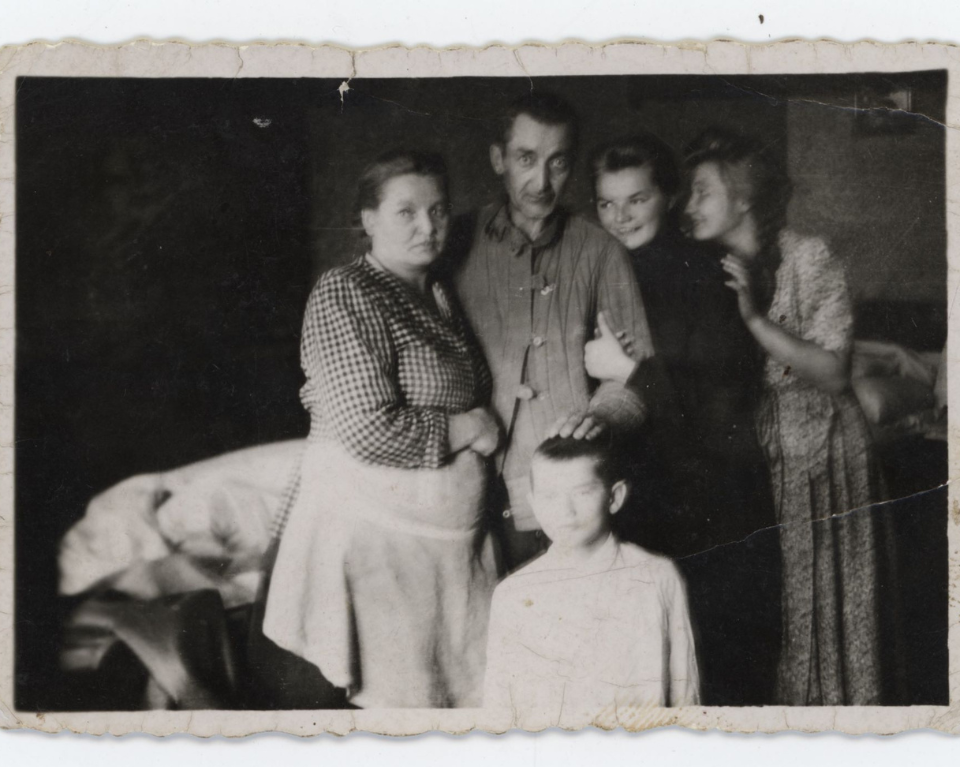
As “Gdanicki” he was deported to Siberia along with two thousand prisoners, of whom four hundred did not survive the journey. The general’s health suffered tremendously under the harsh living conditions, hard labor and starvation. When he was finally allowed to return to Poland in 1947, he settled in Łódź near his wife and daughters, still under a false name. Despite his wife’s attempts to persuade him to leave the country, Fieldorf maintained: “My place is in my country. Here are my scouts, my men, no one should say I was running away from danger.”
He was ill and practically without means of subsistence but wanted to function as normally as possible and support his family. Thus, on November 9, 1950, Fieldorf went to the authorities with documents attesting to the course of his service. After leaving the building, he was pushed into a car and taken to Warsaw. He was transferred to prison at Rakowiecka 37 in Warsaw. During the seventeen-months investigation, the general was beaten and humiliated. The interrogating officers subjected him to emotional torture by threatening to arrest his wife and daughters. Finally, he was charged based on statements by one of his subordinates, which had been extracted through torture. The general was accused of war crimes “to the benefit of the Nazi German occupier”. Fieldorf denied the accusations, which were particularly perfidious given his wartime conducts: He had overseen operations to recover prisoners from the hands of the Gestapo and ordered executions of German war criminals and collaborators (sentenced to death by the Polish Underground).
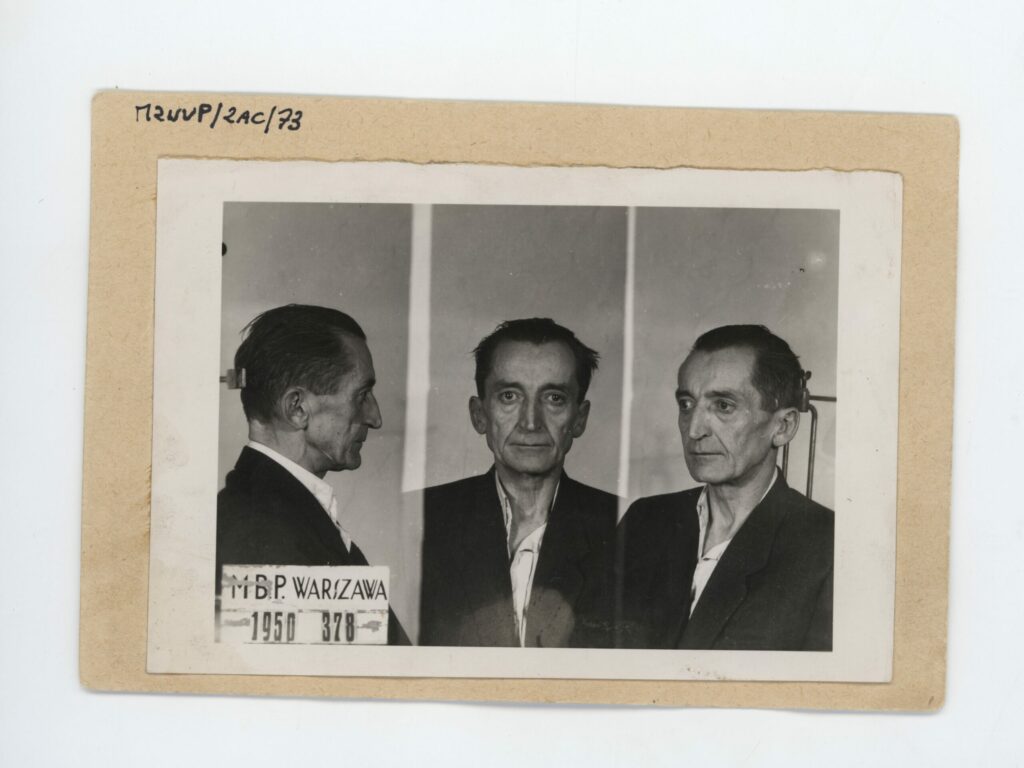
In April 1952, the Voivodeship Court in Warsaw sentenced him to death. The verdict was upheld by the Supreme Court. General Fieldorf strictly forbade his wife to ask the communist authorities for clemency: “Remember, do not ask them for mercy, I forbid it.” In accordance with the communist method of equating heroes and murderers, Emil Fieldorf was placed in a cell with Jacob Sporrenberg, the German war criminal responsible for mass executions.
On 24 February 1953, prosecutor Witold Gatner read the death sentence to the general. “The convict looked me in the eyes the entire time. He was standing upright. No one was holding him up. […] I would describe the convict’s bearing as dignified. He seemed very tough. You could almost admire the composure in the face of such a dramatic event”.
The general’s body was secretly removed and buried in an unknown location. His burial place has not been found to this day. The secret burial of corpses was one of the methods of the communists’ struggle against Polish patriots – it was supposed to prevent the emergence of a cult around the hero’s grave. Despite this, the memory of the general and his achievements during both wars, his merits for Poland, but also the memory of his brutal murder, remain vivid in Polish society.
Text by Anna Śnieżko, in collaboration with Maria Krasnodębska